
Baldwin Projected and Actual Release
A projected date is a planning estimate. An actual release date records when custody ended or changed. GDC may show sentence data, a maximum release date, or a release field for a state prisoner. The Parole Board may show a Tentative Parole Month, called a TPM. Neither a TPM nor a projected date proves that a person left custody that day.
A pretrial detainee at Baldwin County Jail usually has no fixed sentence-release date. Bond, dismissal, a plea, court order, transfer, or time served may determine when local custody ends. A sentenced person awaiting GDC pickup follows another path. Transfer to Baldwin State Prison, Riverbend, or another state facility is not community release.
| Term | Meaning | Best source |
|---|---|---|
| Bond release | Local custody ends under court terms | Jail and docket |
| Maximum release | Sentence endpoint in GDC data | GDC and sentence |
| TPM | Month for final parole review | Parole Board |
| Actual release | Recorded exit or transfer | Custody agency |
Find a Baldwin Projected Release Date
Start with the facility. For Baldwin State Prison or Riverbend, use GDC Find an Offender. Accept the disclaimer and search by GDC ID when possible. A partial name with all-offender scope is safer than many narrow filters. For Baldwin County Jail, call booking or use the Sheriff's records channel and pair that information with the court docket.
- Confirm county jail, GDC, another jurisdiction, or community status.
- For GDC, search the ID or partial name and include all or inactive offenders.
- Open the match and note institution, sentence status, offense, conviction county, and dates.
- Check the TPM route if parole appears.
- For a county case, read the Baldwin docket for bond, sentence, dismissal, revocation, or transfer.
- Request written agency confirmation when the exact date matters.
GDC has institution, scope, sentence-status, and released-in-the-past-15-days controls. That recent option is statewide GDC data, not a Baldwin jail feed. Its data is periodic, not real time.
| Field | Useful choice | Caution |
|---|---|---|
| Offender ID | Exact ID | Best match |
| Scope | All or inactive | Active-only omits releases |
| Status | Released past 15 days | Statewide only |
| Institution | Baldwin or Riverbend | Transfers can confuse results |
Baldwin Release Credit Rules Differ
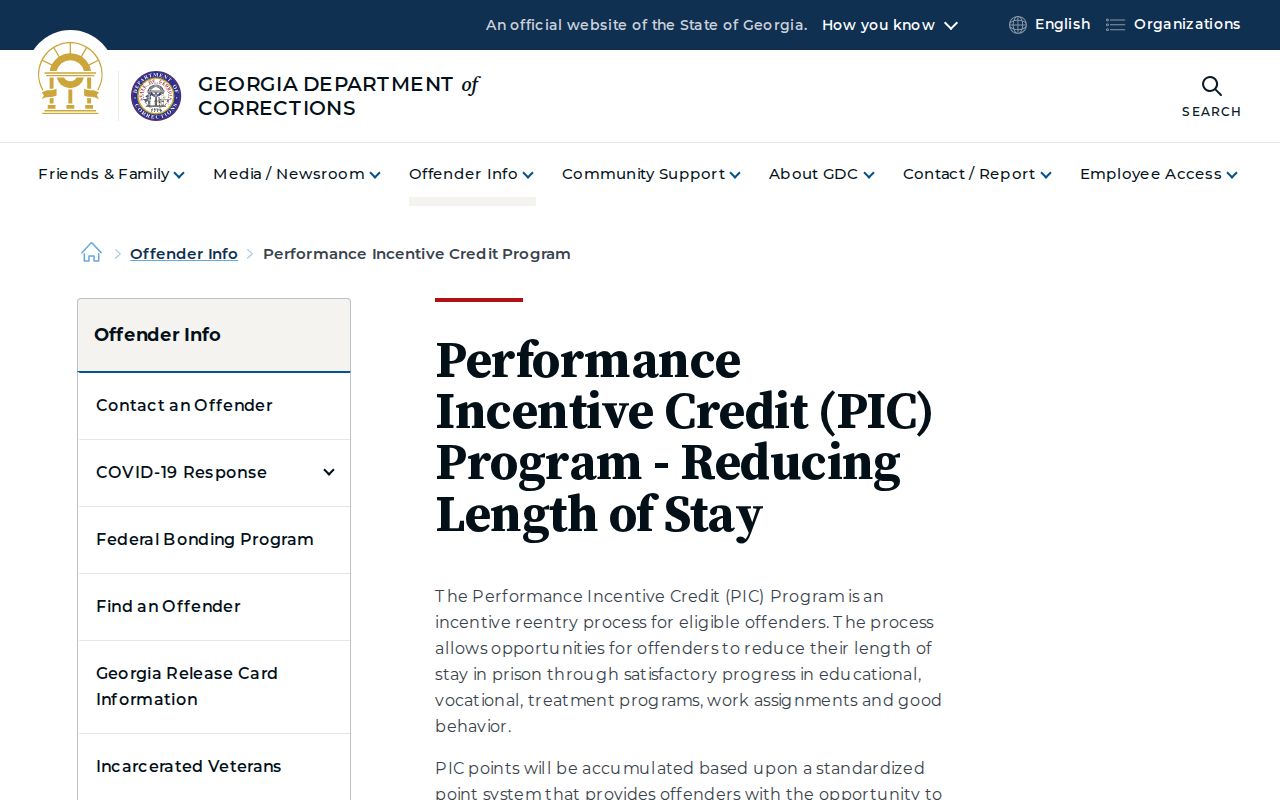
Georgia does not use one simple percentage for every Baldwin release. GDC Performance Incentive Credit, or PIC, can reduce a qualifying offender's TPM or maximum release date by up to twelve months. Eligibility and any award depend on program rules and conduct. PIC is not county jail credit, bond, parole eligibility, or time already served.
O.C.G.A. 42-5-101 governs work incentive credits. Serious violent felony rules in O.C.G.A. 17-10-6-1 can impose mandatory terms and restrict reductions. Life-sentence eligibility can depend on offense date. Read the actual sentence, GDC status, and Board decision together.
The official PIC source below is matched in the successful image manifest.
Why Baldwin Release Dates Change
A date moves when legal or custody facts change. Jail staff can explain a local hold or transfer. GDC holds sentence and institutional status. The Board controls parole decisions, while the court controls sentence orders and many local releases.
| Change | Effect | Confirm with |
|---|---|---|
| Bond or order | Earlier or later local release | Court and jail |
| Credit award or loss | Adjusted state target | GDC |
| TPM change | Parole plan moves | Board |
| Program condition | Release waits | Board and GDC |
| Detainer | Transfer, not community release | Custody agencies |
| New case | Added custody | Court and DCS |
A detainer is authority or a request to hold or transfer someone for another agency. Thus, release from one Baldwin facility may mean transfer to GDC, another county, federal authorities, or immigration custody.
Confirm Baldwin Actual Release
After the expected date, check the source that held custody. Baldwin booking staff answer immediate jail-status questions at 478-445-2663. A written Sheriff's open-records request can seek the release entry, reason, and transfer destination. The court docket can show the order behind the change.
For state prison, search GDC again with all-offender scope. Inactive or released status suggests the end of GDC confinement, but verify parole, discharge, transfer, or another outcome. If parole applies, use the parolee tool and DCS Milledgeville. The Baldwin VINELink inmate search may provide a custody alert, but VINE is not the final record.
Written GDC verification goes to Inmate Records and Information at PO Box 1529, Forsyth, GA 31029. GDC warns that online data may be incomplete. Preserve the date and exact wording of each check.
How Georgia Computes Baldwin Release
County and state paths must stay separate. Pretrial bond depends on a court order and local processing. A county sentence may end through time served. A GDC maximum date reflects state sentence administration. A TPM reflects parole review, and PIC may reduce an eligible TPM or maximum date.
Serious violent felony restrictions defeat the assumption that all prisoners earn the same cut. Program completion and good conduct can affect parole plans. The Board can change a tentative plan before release. No exact Baldwin projected release date can be calculated from a charge name alone.
Use the sentence as the start, then match it to the custody record. If terms conflict, ask which date controls and whether a detainer, consecutive sentence, or parole condition remains.
Note: A projected date answers when release may occur; only the originating agency confirms when custody changed.
Baldwin Jail and GDC Dates
A Baldwin County Jail record and a GDC record describe different stages. The jail can record booking, bond, release, or transfer. GDC records a state sentence, institution, sentence status, and state release fields. If a Superior Court sentence sends someone to GDC, the local jail may mark that person released to another agency even though confinement continues.
The Baldwin court docket supplies the legal bridge. It may show bond, plea, sentence, revocation, commitment, dismissal, or another order. Compare the order date with the jail event and the first GDC status. Small timing gaps can reflect transport and data updates, not an unexplained period of freedom.
For someone still awaiting trial, do not apply prison-credit rules. Call booking for present status and inspect the docket for the next court action. If the person has a county sentence, ask which office calculates credit and which written entry will show completion. Research did not establish a universal Baldwin jail formula, so no fixed local reduction should be assumed.
Baldwin TPM Is Not Release
The State Board of Pardons and Paroles defines a Tentative Parole Month as the month when final review should occur. If release remains appropriate, the Board can then set a parole date. Good prison conduct and completion of named counseling or other conditions can be required. The Board may change the plan before the person leaves prison.
Georgia's ordinary parole decision process is a file review, not a public inmate-appearance hearing. Hearing examiners review the case and apply guidelines for eligible non-life-sentence cases. The Board can establish, deny, defer, postpone, or rescind a tentative plan. A family member should therefore keep the TPM, final Board notice, and actual GDC event separate.
The parolee search becomes useful after release to parole. DCS Milledgeville may then confirm the local supervising office for a Baldwin-area plan. A blank parolee result before the projected date does not cancel the sentence, and a future TPM does not promise the exact day.
Baldwin Release Holds and Transfers
A hold can keep a person confined after the date someone expected. It can arise from another county, a state sentence, federal process, immigration authority, or a new court order. The releasing agency's record should identify the transfer or hold when that information is releasable.
Baldwin's Sheriff publishes GA HB1105 reports describing local immigration-cooperation duties and detainer handling. In that setting, release from the county jail may lead to an ICE transfer rather than community return. Likewise, a GDC pickup ends local jail custody but starts state custody. Ask booking whether the person was released to another agency, then use that agency's locator.
Federal sentenced prisoners belong in the BOP locator, not GDC. A federal pretrial detainee may require the federal docket or U.S. Marshals channel. These systems should be checked only when the record points to that jurisdiction.
Document Baldwin Release Dates
Save the person's identifiers, the source name, the exact field label, and the time checked. “Maximum release,” “TPM,” “released,” “inactive,” and “not in custody” are not interchangeable. A screenshot is a useful lead, but a written agency record or certified court order is stronger proof.
The Baldwin Clerk advertises online civil and criminal case search plus eCertification through The Clerks Authority. A certified sentence or disposition can resolve which term the agency must administer. For a county jail event, ask the Sheriff for the booking and release entry. For GDC, use written correspondence with Inmate Records and Information.
If records disagree, do not average the dates or select the earliest one. Ask the custody agency whether a later order, credit decision, detainer, consecutive sentence, or data delay explains the conflict. Exact questions tend to produce better routing than a broad request for “all release information.”
Baldwin Court Orders Control Release
The court record is essential when a projected date turns on a local sentence, bond, or later order. Baldwin's Clerk page provides online criminal case search, while The Clerks Authority supports requests for certified records. A docket entry can show why the expected date changed before another custody database updates.
Read entries in order. A bond order may authorize release but still require jail processing and resolution of other holds. A sentencing order may award time-served credit, impose probation, or commit the person to GDC. A revocation may change the balance between confinement and community supervision. Each event needs the document that created it.
If the court sends the person to GDC, switch from local date questions to the GDC sentence record after intake. If the order ends confinement, request the jail release entry for the actual time and basis. Court authority and custody execution are related but distinct records.
Baldwin Release Data Update Timing
GDC says its offender data is a periodic snapshot and not real time. The booking line may reflect the jail's operational system sooner, while the docket follows the clerk's posting cycle. VINE depends on a participating agency feed. Timing differences are expected.
Search less narrowly when a released GDC record seems missing. Use all-offender scope, a partial last name, and the ID when available. Then confirm through written correspondence. For a recent county event, call booking first and use open records when written proof is needed.